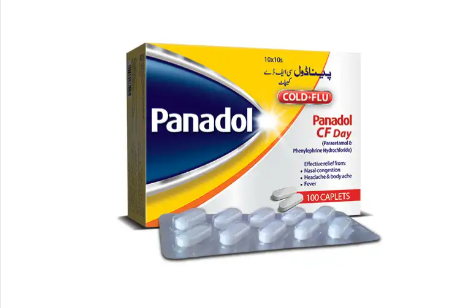
Panadol
4.2 Posology and method of administration
Adults, Elderly and Children over 16 years:
Two tablets every four hours as required. Not more than eight tablets in 24 hours. Do not take for more than 3 days without consulting your doctor.
These doses should not be given more frequently than every four hours nor should more than four doses be given in any 24 hour period.
Children aged 10 to 15 years:
One tablet every four to six hours when necessary to a maximum of four doses in 24 hours. Do not take for more than 3 days without consulting your doctor.
These doses should not be repeated more frequently than every four to six hours nor should more than four doses be given in any 24 hour period.
Method of administration: For oral administration
4.3 Contraindications
Hypersensitivity to the active substance or to any of the excipients listed in section 6.1
4.4 Special warnings and precautions for use
Paediatric population: Not recommended for children under the age of 10 years.
Care is advised in the administration of paracetamol to patients with severe renal or severe hepatic impairment. The hazard of overdose is greater in those with non-cirrhotic alcoholic liver disease. Do not exceed the recommended dose. Do not take for more than 3 days without consulting a doctor. Do not take with any other paracetamol-containing products. If symptoms persist consult your doctor. Keep out of the reach of children.
Cases of high anion gap metabolic acidosis (HAGMA) due to pyroglutamic acidosis have been reported in patients with severe illness such as severe renal impairment and sepsis, or in patients with malnutrition or other sources of glutathione deficiency (e.g. chronic alcoholism) who were treated with paracetamol at therapeutic dose for a prolonged period or a combination of paracetamol and flucloxacillin. If HAGMA due to pyroglutamic acidosis is suspected, prompt discontinuation of paracetamol and close monitoring is recommended. The measurement of urinary 5-oxoproline may be useful to identify pyroglutamic acidosis as underlying cause of HAGMA in patients with multiple risk factors.