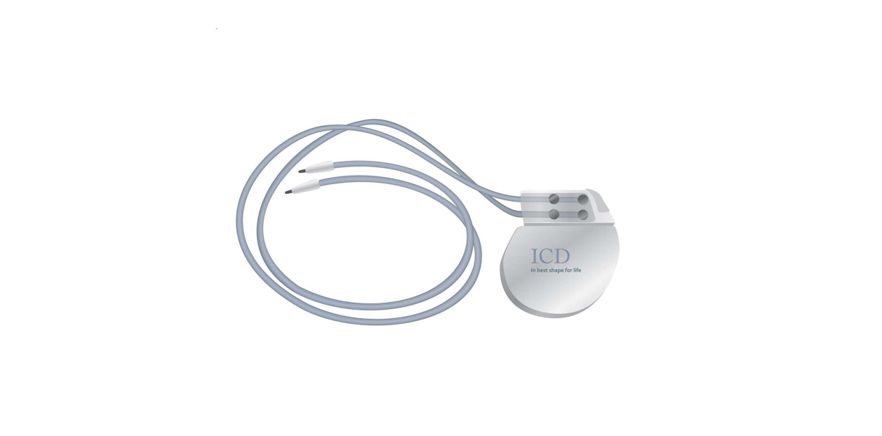
Implantable Defibrillator
An implantable cardioverter-defibrillator (ICD) or automated implantable cardioverter defibrillator (AICD) is a device implantable inside the body, able to perform defibrillation, and depending on the type, cardioversion and pacing of the heart. The ICD is the first-line treatment and prophylactic therapy for patients at risk for sudden cardiac death due to ventricular fibrillation and ventricular tachycardia.[1][2]
"AICD" was trademarked by the Boston Scientific corporation, so the more generic "ICD" is preferred terminology.
A single chamber ICD with its right ventricular lead connected into the header; note, starting from the end of the lead, the tip and adjacent first ring, used to sense the cardiac electrical activity and stimulate the right ventricle, the coil and the two rings for atrial sensing.
On average ICD batteries last from six to ten years.[3] Advances in technology, such as batteries with more capacity or rechargeable batteries,[4] may allow batteries to last for more than ten years. The leads (electrical cable wires connecting the device to the heart) have much longer average longevity, but can malfunction in various ways, specifically insulation failure or fracture of the conductor; thus, ICDs and leads generally require replacement every 5 to 10 years.[5][6]
A normal chest X-ray after placement of an ICD, showing the ICD generator in the upper left chest and the ICD lead in the right ventricle of the heart. Note the 2 opaque coils along the ICD lead.
The process of implantation of an ICD system is similar to implantation of an artificial pacemaker. The first component or generator contains a computer chip or circuitry with RAM (memory), programmable software, a capacitor and a battery; this is implanted typically under the skin in the left upper chest. The second part of the system is an electrode wire or wires that, similar to pacemakers, are connected to the generator and passed through a vein to the right chambers of the heart. The lead usually lodges in the apex or septum of the right ventricle.[7]
Just like pacemakers, ICDs can have a single wire or lead in the heart (in the right ventricle, single chamber ICD), two leads (in the right atrium and right ventricle, dual chamber ICD) or three leads (biventricular ICD, one in the right atrium, one in the right ventricle and one on the outer wall of the left ventricle). The difference between pacemakers and ICDs is that pacemakers are also available as temporary units and are generally designed to correct slow heart rates, i.e. bradycardia, while ICDs are often permanent safeguards against sudden life-threatening arrhythmias.
S-ICD lead and generator position
Sketch of an already-implanted cardioverter-defibrillator
Recent developments include the subcutaneous ICD (S-ICD) which is placed entirely under the skin, leaving the vessels and heart untouched. [8] Implantation with an S-ICD is regarded as a procedure with even less risks, and is currently suggested for patients with a previous history of infection or increased risk of infection. It is also recommended for very active patients, younger patients who will likely outlive their transvenous ICD (TV-ICD) leads and those with complicated anatomy/arterial access. S-ICDs are not able to be used in patients with ventricular tachycardia or bradycardia.[9]