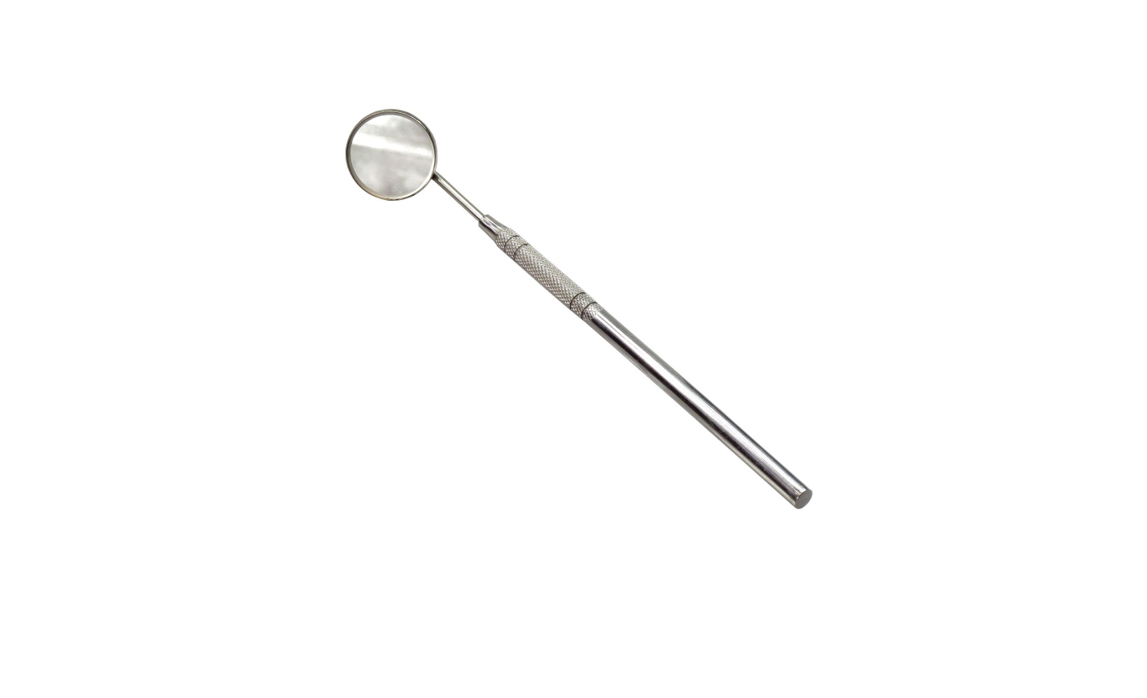
Dental Mirror
Dentists have long used small, handheld mirrors when performing dental procedures such as oral surgery and restorative dentistry. The stereotypical dental mirror has a stainless handle with a reflecting surface affixed at an angle on the end of the handle. The reflecting surface in such a dental mirror is usually provided by a conventional glass mirror.
Such dental mirrors have disadvantages. They are costly to manufacture. They have a high tendency to fog up due to the relatively large heat capacity and conductance of the glass and metal materials. This type of dental mirror also requires sterilization between patients via chemical or thermal processes.
Additionally, although the material in these dental mirrors can withstand chemical and thermal sterilization, the interface between the glass reflective surface and the metal handle is susceptible to retaining germs which may occasionally survive the sterilization process. Even when sterilization of the mirror is successful, unsightly debris and grit may be trapped in the gap around the glass mirror, and can be difficult to remove.
The cost of dental mirrors becomes an important factor with a new dental technique called air abrasive dentistry. In this procedure, the dental drill normally used to remove decayed tooth material is supplemented or replaced by a high velocity air stream containing particles which abrade away the decayed tooth portions. In such procedures, an inherent problem is that some of the abrasive particles will ricochet off the tooth and impact the mirror surface with sufficient velocity to etch and damage it. Dental mirrors used in such procedures can have a very short lifetime, depending on the location of the cavity, and can become unusable within a few seconds.
For these and other reasons, disposable dental mirrors have become popular in recent years. Disposable dental mirrors may be discarded after use so sterilization is not needed and transmission of viable pathogens between patients is completely avoided. In order to be economically viable, a disposable dental mirror must be very inexpensive to manufacture.
Typically, disposable dental mirrors are similar in configuration to the conventional, non-disposable mirror described above, but are made with less expensive materials. Handles may be a plastic material which can be made in large quantities at low expense by injection molding or other modern manufacturing methods. The reflecting surface is most often provided by a glass mirror.